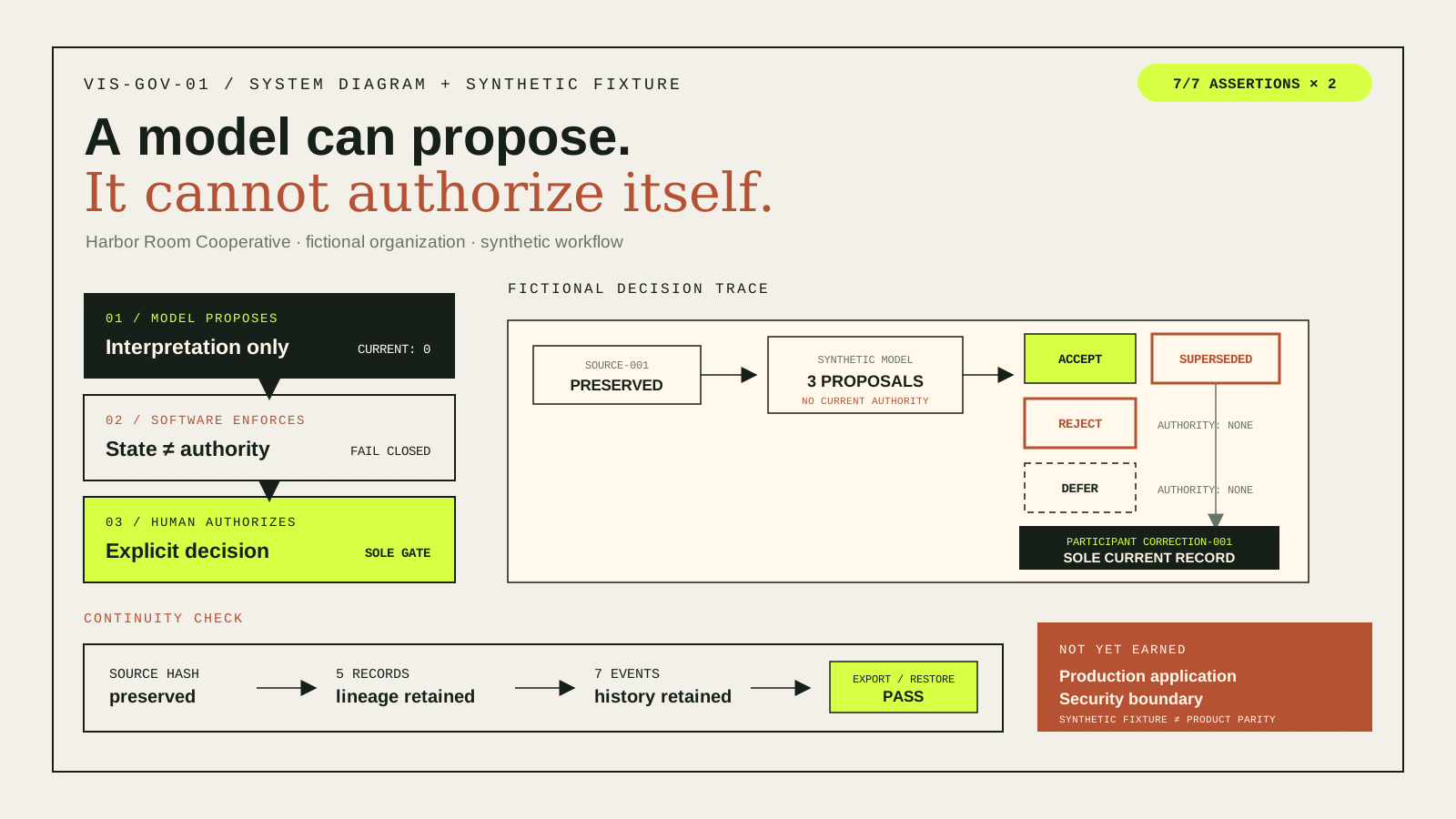
A local-first application where model output, software capability, and human authority remain separate—and an adversarial failure changed the storage architecture.
The decision
A model may propose. Software may enforce. A human remains the source of authority.
Problem
A useful AI interface can quietly promote fluent interpretation into institutional state. The application needed to preserve source evidence, constrain privileged transitions, retain correction lineage, and survive export and restoration without allowing model output to approve itself.
Intervention
A typed interface was placed above a constrained Rust transition boundary and bundled SQLite store. After the first design passed only 7 of 35 structural attacks, the storage kernel gained database constraints, authenticated append-only records, anchored exports, collision-safe restore, owner-only storage, runtime model checks, and fail-closed migration behavior.
Observed result
The corrected reference kernel passed its original and expanded adversarial corpora. A public-safe Harbor Room fixture reproduced accept, reject, defer, supersession, export, and restore without exposing private institutional state.
Verified evidence
What the record supports.
Initial structure
7 / 35
Corrected corpus
35 / 35
Expanded resilience
45 / 45
Hostile context
12 / 12
Public fixture
7 / 7 × 2
Original source preserved with independent hash
Rejected and deferred proposals retained without authority
Participant correction became the sole current record
Two fixture runs produced byte-identical results
Public evidence files
Inspect the record.
Public-safe derivatives only. Source availability does not broaden the claim stated on this page.
No installer, notarized distribution, or clean-machine support
No encrypted-storage or key-recovery claim
No sustained external adoption or commercial readiness claim
Next evidence
Complete distribution, accessibility, security, supported-environment, and independent-review gates without weakening the demonstrated authority model.